

Banner
Menu

Category: Uncategorized

73% Of Homes Sell In Under In A Month


New numbers from the National Association of Realtors show just how quickly homes are selling these days. Their monthly measure of existing-home sales found that the typical property sold in 21 days in November. In fact, 73 percent of homes sold were on the market for less than a month. Lawrence Yun, NAR’s chief economist, says that the housing market continues to thrive. “Home sales in November took a marginal step back, but sales for all of 2020 are already on pace to surpass last year’s levels,†Yun said. “Given the COVID-19 pandemic, it’s amazing that the housing sector is outperforming expectations.†November sales were down slightly from the previous month but remain 25.8 percent higher than they were last year at the same time. However, while buyer demand remains high, so do prices. Fewer homes available for sale has caused them to spike, with each major region showing double-digit increases from one year ago.
Close-up of a green 'For Sale' sign with bold white letters.

What Will The 2021 Housing Market Look Like?


At the end of every year, experts and industry analysts release predictions for what they think the housing market will look like in the year ahead. These forecasts hope to accurately answer what will happen to things like home sales, prices, and mortgage rates over the next 12 months. And, according to at least one of them, the 2021 market should be hot. The forecast, released by a popular online real-estate portal, says there are a few factors that will combine to produce the busiest spring shopping season in years. One is buyer demand. In 2020, home sales are expected to be up 6 percent from the year before, and that’s with a weeks-long interruption during the height of the spring season. Next year should bring out even more buyers. Mortgage rates are expected to stay low, at least through the first half of the year. That will help counteract any price increases and keep affordability manageable. Buyer demand will also benefit from the coronavirus vaccine. With distribution expected to be well underway by spring, the vaccine should help reduce uncertainty and give prospective home shoppers more motivation to make a move. All in all, it looks like the 2021 housing market will be a busy – and competitive – one.

The year 2021 filled with diverse moments and memories.

New Home Construction Ends The Year Strong


The number of homes available for sale has been lower than normal for a while now. In many markets, there aren’t enough homes for sale to meet buyer demand, and – since there are more buyers than available homes – prices and competition continue to rise. In short, more new homes are needed. So it’s encouraging that the most recent residential construction report from the U.S. Census Bureau and the Department of Housing and Urban Development shows more new homes are under construction and permits to build are also on the rise. According to the report, building permits are now 8.5 percent higher than they were last year at the same time. Additionally, the number of new homes that began construction in November was 12.8 percent higher than November 2019. It marks the seventh-consecutive month that single-family home construction has increased. In other words, new home construction is accelerating, even as the broader economy slows. That bodes well for the 2021 housing market, as an increasing supply of new homes will help bring balance to the market and moderate any future home-price spikes. (source)

Close-up of a claw hammer with a wooden handle on a white background.

Builders Optimistic Heading Into New Year


The National Association of Home Builders conducts a monthly survey to measure how optimistic builders are in the market for newly built homes. Their Housing Market Index scores responses on a scale where any number above 50 indicates more builders view conditions as good than poor. The results are seen as a good indicator of housing health, as a home builder’s business is dependent on being able to read the market and anticipate buyer demand. In December, the Index fell four points to 86, after hitting a record high of 90 the month before. Robert Dietz, NAHB’s chief economist, says the housing market is a bright spot in the economy, but will face some challenges in the year ahead. “Builder confidence fell back from historic levels in December, as housing remains a bright spot for a recovering economy,†Dietz said. “The issues that have limited housing supply in recent years, including land and material availability and a persistent skilled labor shortage, will continue to place upward pressure on constructions costs.†(source)

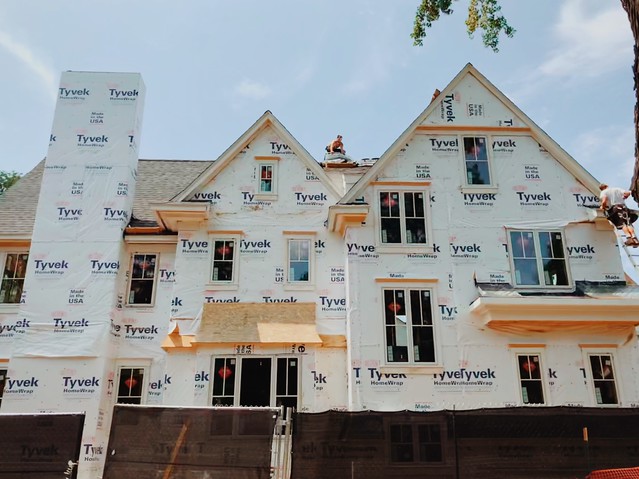
A house under construction with exposed framing and Tyvek wrap.

How Much Is The Median Down Payment Now?

In the minds of home buyers, there are two big numbers to consider. One is the monthly mortgage payment. Calculating what a particular house will cost you each month is an important determiner of whether or not you can really afford it. But you can’t calculate your prospective monthly mortgage payment without knowing first what your down payment will be. That’s why the down payment is the other number home buyers have to grapple with before buying. Figuring out how much you will potentially have to put down on a house and where you will get the money are among the first questions prospective buyers should address. So what should they expect their down payment to be? Well, it depends on where they’re buying, of course. A down payment in San Francisco is going to be a lot different than a down payment in Kansas City. But, according to one recent analysis, the median down payment nationally, during the third quarter of 2020, was $20,775. That’s 6.6 percent of the median sales price for homes purchased during the same period. It’s also good place to start when thinking about how much you’ll need to put toward your next house. (source)

Money

Commute To Work Falls From Top Buyer Concerns


In the past, shopping for a house to buy involved calculating how difficult your commute to work would be. Whether it was measuring the distance to public transportation, the nearest highway, or timing the total drive, home buyers had to consider their daily routine before making an offer. Then, COVID hit and changed everything. Now, with more Americans working from home, commutes are becoming less of a factor in home buying decisions and it’s changing how and where we buy. For example, a recent survey found that 40 percent of Americans who have recently moved or plan to soon are relocating more than 100 miles away – half of them are moving over 500 miles away. Additionally, real-estate professionals report that they are seeing more city-to-suburb moves and are getting far fewer requests for homes close to transportation options. And now it’s looking like the change will be permanent. In fact, three out of four consumers who have moved or are planning a move say they don’t plan to return to the area where they lived pre-pandemic. (source)

Close-up of yellow road lines on a forested mountain road.

Mortgage Rates Hit New Lows In Weekly Survey

According to the Mortgage Bankers Association’s Weekly Applications Survey, average mortgage rates fell to new lows last week, with rates for 30-year fixed-rate mortgages with conforming loan balances, loans backed by the Federal Housing Administration, and 15-year fixed-rate loans down from the week before. Rates for loans with jumbo balances were flat from the previous week. Joel Kan, MBA’s associate vice president of economic and industry forecasting, says low rates spurred a bump in refinance applications. “Refinance activity increased last week in response to mortgage rates for 30-year, 15-year, and FHA and VA refinances, while conventional activity fell slightly,” Kan said. “The purchase market is also poised to finish 2020 on a strong note. Applications fell slightly last week but were around 3 percent higher than the two weeks leading up to Thanksgiving.” Overall, demand for mortgage loan applications was down 1.2 percent from the week before, with an adjustment for the holiday. The MBA’s weekly survey has been conducted since 1990 and covers 75 percent of all retail residential mortgage applications. (source)

Number Of Showings Per Listing Stays High


Typically, this is the time of year when buyers put a pause on house hunting and wait until spring. However, this year is different. Evidence continues to show that the housing market is defying seasonal trends as we head into winter. For example, according to one recent analysis, buyer demand is still surging in many markets across the country, with some seeing twice as many house showings per listing compared to the same time last year. In fact, several markets have recorded double-digit showings per listing – significantly higher than the current average of six per listing. In other words, there are still plenty of interested buyers. So why haven’t we seen a seasonal slowdown? Well, one factor is COVID-19. Delayed demand from spring has been pushed later into the year. Another factor is the combination of favorable mortgage rates and low for-sale inventory. Together, they’ve driven traffic 60.9 percent higher than it was last year at the same time – with the Northeast up 65.5 percent and the West seeing traffic 64.7 percent higher than one year ago. (source)

Sign announcing an upcoming event or opening with 'Coming Soon!' text.

Home Purchase Sentiment Retreats From Peak


Each month, Fannie Mae’s Home Purchase Sentiment Index tracks how Americans feel about the housing market, buying and selling a home, mortgage rates, prices, their job, and income. The index is a monthly measure of home buying conditions and consumer confidence in the real-estate market. In November, the HPSI fell 1.7 points, marking the first decline after three consecutive months of increases. Doug Duncan, Fannie Mae’s senior vice president and chief economist, says consumer sentiment may have peaked for now. “The HPSI appears to have peaked for now as consumers continue to consider how COVID-19 impacts their ability to buy or sell a home,†Duncan said. “Drilling down a bit, home purchase confidence has recovered more for homeowners than renters, in part because homeowners have been less likely than renters to have had their jobs and finances impacted by the pandemic.†Among the results, the number of respondents who said now is a good time to buy a home fell 3 percent, while the number of participants who feel it’s a good time to sell remained unchanged from the previous month. (source)

A red house with a single white window under a clear blue sky.

Half Of Americans Say They’re Ready To Move


The idea of packing up your things and moving somewhere new can be exciting – especially if your current living situation isn’t ideal. So it’s not surprising that a recent survey found nearly half of Americans say they’re considering a move in the next year. According to the results, 46 percent of respondents said they’re thinking about moving. Among them, 27 percent said they’re looking for a new place in their current area, 12 percent were hoping to find a home in another part of the state, and 8 percent said they’re considering moving out of state. But what are the main factors causing so many of us to think about starting fresh somewhere else? Well, most respondents said money. In fact, 44 percent of people who said they’re considering moving said they were doing so because their current home was too expensive. Other reasons participants offered included that their home was too small, they wanted different features, they’d rather live in a different part of town, and they’re unhappy with the management at the property they’re renting. (source)

Red plastic tape dispenser holding a roll of transparent adhesive tape.

Thank you for your upload