

Banner
Menu

Category: Uncategorized

Lenders Say Credit Standards Have Eased


Fannie Mae’s quarterly Mortgage Lender Sentiment Survey polls senior executives to assess their views and outlook on a number of topics related to the mortgage market. The results provide an insider’s perspective on credit standards, demand, the economy, and more. According to the most recent survey, when asked whether their lending organization’s credit standards have eased, tightened, or remained unchanged over the past three months, the gap between those saying they’ve eased and those reporting stricter standards increased to 20 percent, a new survey high. Doug Duncan, senior vice president and chief economist at Fannie Mae, said it was the first time in seven quarters that there was a pronounced increase in the share of lenders reporting on net an easing of credit standards. “This is a significant result in light of public discourse on credit availability and standards,†Duncan said. “Overall, we expect that lenders’ tendency toward easing credit standards, together with relatively low mortgage rates and a strengthening labor market, will continue to support the housing market expansion.†More here.

Scrabble tiles spelling 'CREDIT' over US dollar bills.

Is Buying A Home More Affordable This Year?


Continuing home price increases and rumors of mortgage rate hikes have the combined effect of convincing many potential home buyers that affordability conditions have worsened this year. But, according to a new analysis from RealtyTrac and Clear Capital, buying a home was actually at its most affordable level in two years during the first quarter of 2015. The analysis looked at weekly wage data from the Bureau of Labor Statistics, average prices for single-family homes and condos, and average interest rates on 30-year fixed-rate mortgages. The results show that – though home price appreciation outpaced average wage growth between the first quarter of 2014 and the first quarter of 2015 in 68 percent of the analyzed counties – average interest rates dropped at the same time. Because of this, buying a home required a smaller share of the average wage compared to a year earlier in 339 of the 582 counties included in the analysis. Daren Blomquist, RealtyTrac’s vice president, says the results were surprising. “Although home prices continue to outpace wage growth in the majority of local markets, this analysis somewhat surprisingly shows that affordability is actually improving in most markets thanks to falling interest rates and slowing home price growth, which is allowing wage growth to catch up in some markets,†Blomquist said. “At the national level, buying an average-priced home in the first quarter of 2015 was the most affordable it’s been in two years and nearly twice as affordable as it was in the second quarter of 2006 – when affordability was its worst in the past 10 years.†More here.

A clenched fist holding dollar bills against a red background.

Mortgage Demand Up 20% From Last Year


According to the Mortgage Bankers Association’s Weekly Applications Survey, demand for mortgage purchase applications is now 20 percent higher than it was at the same time last year. Rising application demand is evidence that more Americans are interested in buying a home and have begun the mortgage process. But, despite the improvement over last year, the survey’s results also show that, when compared to one week earlier, overall demand has dropped. In fact, refinance activity was down 8 percent and purchase demand dropped 6 percent. The slowdown follows a recent spike in activity and comes on a week when average mortgage rates fell. According to the report, the average contract interest rate for 30-year fixed-rate mortgages with both conforming and jumbo balances dropped from the week before, as did rates for loans backed by the Federal Housing Administration and 15-year fixed-rate mortgages. Michael Fratantoni, MBA’s chief economist, told CNBC the weekly average mortgage rate isn’t telling the whole story. “The prior week included days with much lower rates due to volatility around the Fed’s announcement that drove refinance volume up,†Fratantoni said. “Last week, a more stable rate produced less volume, as rates at this level just do not provide an incentive for most homeowners to refinance.†The MBA’s weekly survey has been conducted since 1990 and covers 75 percent of all retail residential mortgage applications. More here.

A cracked yellow arrow painted on a dark surface pointing upward.

Housing On Track Despite Economic Volatility


Fannie Mae’s Economic and Strategic Research Group releases an updated outlook for the economy and housing market each month. Their forecast provides a good view of where things are and where they’re headed. According to this month’s release, recent economic volatility may cause heightened concern on Wall Street but shouldn’t negatively affect economic growth or the progress the housing market has made over the past year. In fact, Fannie Mae points to an uptick in consumer spending, full-time employment surpassing its pre-recession peak, and the fact that average hourly earnings have increased as an indication that the economy will remain on track through the end of the year. Their housing market forecast also remains mostly unaffected by recent data. “Continued strong performance of year-to-date home sales and modestly weakening leading indicators confirm that our prior forecast of existing home sales this year remains valid,†Doug Duncan, Fannie Mae’s chief economist, said. “However, lower actual and projected cash sales led us to revise slightly higher purchase mortgage originations.†In fact, Duncan believes total mortgage originations this year will be up approximately 25 percent over last year. More here.

Row of houses silhouetted against a bright blue sky.

Pending Home Sales Slip But Remain Strong


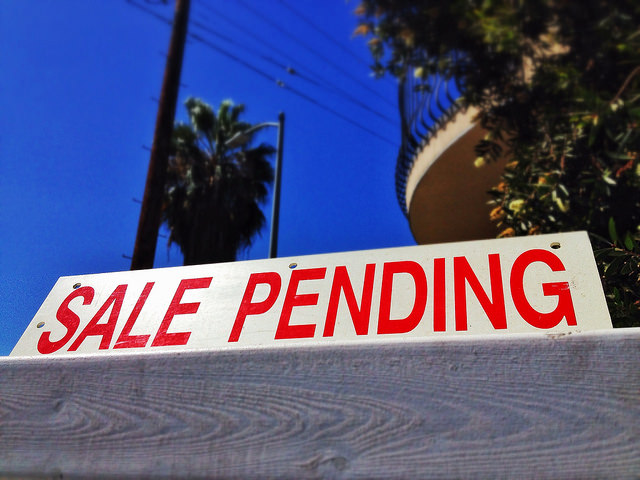
The National Association of Realtors’ Pending Home Sales Index measures the number of contracts signed to buy homes each month. Because it measures contract signings – and not closings – it is a good indicator of future home sales. In August, the index fell 1.4 percent. Despite the dip, however, it remains 6.1 percent above last year’s level and has now risen over year-before levels for 12 consecutive months. Lawrence Yun, NAR’s chief economist said, even with the slight decline, demand is outpacing housing supply, which will continue to put upward pressure on home prices. “Pending sales have leveled off since mid-summer, with buyers being bounded by rising prices and few available and affordable properties within their budget,†Yun said. “Even with existing-housing supply barely budging all summer and no relief coming from new construction, contract activity is still higher than earlier this year and a year ago.†In other words, despite a slightly more challenging environment for buyers, demand is still healthy. In fact, a closer look at the numbers reveals that pending home sales were actually up in the West and unchanged from last month in the Midwest. Which means, August’s declines were confined to the South and Northeast. More here.

A red and white 'Sale Pending' sign outdoors against a blue sky.

Survey Reveals Homeowners’ Top Complaints


When shopping for a house to buy, most prospective buyers will make a list of features they’d like – whether it’s an open floor plan or a place for entertaining. They will also, most likely, have a list of things they’d like to avoid. But despite all the careful thought and consideration they may’ve put into finding the perfect home, once they’ve settled in there will inevitably be a few things they never knew they needed and some issues they hadn’t even thought of during the house hunt. Because of this, it can be helpful for home shoppers to get a feel for what current homeowners most dislike about their home and neighborhood. Fortunately, a recent survey conducted by HSH.com polled Americans and asked them what most upsets them about their current living arrangement. Not surprisingly, when it comes to the home itself, the number one complaint was a lack of storage. Too much maintenance, insects, wildlife, and being too old, not updated, and small were all among the top complaints. Among the more unexpected responses, 25 percent named water pressure as a problem, while 30 percent said lack of parking. When it comes to the neighborhood and their neighbors, there are few things that don’t ruffle feathers. Noisy, messy neighbors who are unfriendly are an issue for most Americans. Participants also complained about too many teenagers, too much traffic, and their neighbors’ vehicles, pets, and kids. More here.

House facade fully covered with green ivy against a bright blue sky.

New Home Sales Beat Expectations In August


Sales of newly built single-family homes rose 5.7 percent in August, according to new estimates released by the U.S. Census Bureau and the Department of Housing and Urban Development. The improvement puts new home sales 21.6 percent above last year’s level and represents the fastest sales pace in seven years. After falling in June, sales have rebounded strongly. In fact, August’s report includes an upward revision of July’s estimate, which was initially reported as a 5.4 percent increase. It also surpasses economists’ expectations for the month. New home sales are an important indicator of – not only the health of the housing market – but also the overall economy. Strengthening sales are an indication of increasing economic activity, as well as a more stable job market. But though this summer’s sales gain can, in part, be attributed to improved employment conditions, it is also fueled by mortgage rates that remain low by historical standards. Also in the report, the median sales price of new houses sold in August was $292,700; the average sales price was $353,400. At the current sales pace, there was a 4.7-month supply of new homes available for sale. More here.

House under construction wrapped in Tyvek with wooden framing and green trees.

Only 9 Units Left at Lexington Hill Condominium


There are only 9 units left at the New Lexington Hill Condominiums, Originally coined The Glass Spire by renown architect Tom Gilman of Gilman Architects. Gilman is known for combining  sleek and creative designs with innovative green technologies. The East Harlem, Luxury 42 unit New Development of Steel and Glass is now almost completely sold out with only a few choice units remaining.  The sizable one and two bedroom units have gorgeous features and quality materials including oak hardwood flooring, granite counter tops, marble kitchen and baths and private balconies and terraces,  All of the remaining units  have private outdoor space. Developed by Rey Sun Realty LLC. and Marketed by exclusive broker Michael Crespo of Citadel Property Management Corp.  Learn More here.

A small green plant in a white pot on a table in a bright living room.


Mortgage Activity Surges As Rates Dip


According to the Mortgage Bankers Association’s Weekly Applications Survey, the average contract interest rate on 30-year fixed-rate mortgages and those backed by the Federal Housing Administration were unchanged last week from the week before. Rates on jumbo loans and 15-year fixed-rate mortgages both fell, however, during a week when there was considerable volatility due to the Federal Reserve’s decision not to raise interest rates. “We saw significant rate volatility last week surrounding the FOMC meeting, and rate declines toward the end of the week likely drove applications from both prospective home buyers and borrowers looking to refinance,†Mike Fratantoni, MBA’s chief economist, said. “The 30-year fixed-rate remained unchanged over the week even though there was substantial intra-week fluctuation, but we saw rate decreases in other loan products like the 15-year fixed, 5/1 ARM, and 30-year jumbo.†Fluctuating rates led to a spike in application demand, with refinance activity up 18 percent over the previous week and purchase application demand – which is a good indicator of future home sales – up 9 percent, reaching its highest level since June. The MBA’s weekly survey has been conducted since 1990 and covers 75 percent of all retail residential mortgage applications. More here.

Illuminated sign displaying the word 'MORTGAGE' at night.

Rising Equity Benefits Buyers And Sellers


Equity refers to the value of a property minus the amount owed on the mortgage. In short, having positive equity means your home is worth more than you paid for it. In other words, it’s good news. That’s why CoreLogic’s second quarter equity report is an encouraging sign for both current homeowners and potential buyers. According to the report, 759,000 properties regained equity in the second quarter, raising the number of mortgages that are now lower than their property’s value to nearly 46 million, or 91 percent of all mortgaged properties. That is a big improvement over where things were following the housing crash, when millions of homeowners saw their homes lose value and were plunged into negative equity. CoreLogic’s CEO and president, Anand Nallathambi, says the negative equity epidemic is lifting for much of the country. “The biggest reason for this improvement has been the relentless rise in home prices over the past three years which reflects increasing money flows into housing and a lack of housing stock in many markets.†But, though the number of homes available for sale has been low in some markets, a rising number of current homeowners with positive equity could mean more homes put up for sale, giving prospective buyers more choices and reducing the rate of price gains. More here.

Close-up of US $100 bills showing Benjamin Franklin's portrait and security features.

Thank you for your upload