

Banner
Menu

Slight Rate Increase Slows Mortgage Demand


The number of Americans requesting mortgage applications fell 1.3 percent last week, according to the Mortgage Bankers Association’s Weekly Applications Survey. The decline was due, in part, to a slight increase in average mortgage rates. The survey found rates up for 30-year fixed-rate mortgages with both conforming and jumbo balances, as well as 15-year fixed-rate loans. Mortgage rates for loans backed by the Federal Housing Administration were unchanged from the previous week. Michael Fratantoni, MBA’s chief economist, told CNBC that refinance volume remains high while purchase demand has been slow since the holiday. “Recent swings in mortgage rates have been relatively muted compared to Treasury rates, although on net both remain below their levels from just prior to the Brexit vote,†Fratantoni said. “Refinances fell slightly with rising rates last week, but the refinance share of 64.2 percent of applications was the highest since February of this year, as purchase volume was slow to come back following the July 4thholiday.†Demand for loans to buy homes, though 16 percent higher than last year, has been hampered by lower-than-normal inventory levels across much of the country. The MBA’s weekly survey has been conducted since 1990 and covers 75 percent of all retail residential mortgage applications.

Large white percentage symbol on a red background.

New Home Construction Jumps In June


As a home buyer or seller, new residential construction numbers may not seem like they have a whole lot to do with you. But, at a time when there are more buyers than there are homes available for sale, the pace of new home construction has a significant impact on home prices – which are most likely very important to you. In today’s market, for example, home prices are increasing in many areas due to the fact that there is more demand than there is supply. When there are fewer homes for sale, home prices rise as competition among buyers increases. As new homes are built, however, those price increases will begin to moderate and buyers will have more options to choose from. For that reason, the U.S. Census Bureau and the Department of Housing and Urban Development’s New Residential Construction report is widely cited as a good barometer of the housing market’s health. According to the most recent report, new home construction rose more than economists’ expected in June. In fact, the number of single-family homes that began construction during the month was 4.4 percent higher than the month before. The improvement was largely due to a 46.3 percent spike in the Northeast and a 17.4 percent pickup in the West. Also in the report, building permits – which are a good indication of future housing starts – rose 1 percent from May. More  here.

Vintage claw hammer on textured rustic surface.

Builders Still Optimistic About The Market


Because builders have an unique view of the new home market, the National Association of Home Builders tracks their perspective each month as part of their Housing Market Index. The survey has been conducted for 30 years and scores builders’ responses on a scale where any number above 50 indicates more builders view conditions as good than poor. In July, builder confidence was relatively unchanged from the month before, falling one point to 59. Robert Dietz, NAHB’s chief economist, says the market remains poised for growth. “The economic fundamentals are in place for continued slow, steady growth in the housing market,†Dietz said. “Job creation is solid, mortgage rates are at historic lows and household formations are rising. These factors should help to bring more buyers into the market as the year progresses.†Among the survey’s three components, measuring buyer traffic, current sales, and expectations for the next six months, future expectations fell furthest, dropping three points to 66. Regionally, the Midwest, South, and West all continued to post positive numbers, while the Northeast trails behind with a three-month moving average of 39. Builder confidence is considered an important measure of housing’s health due to the important role new homes play in balancing the market. More here.

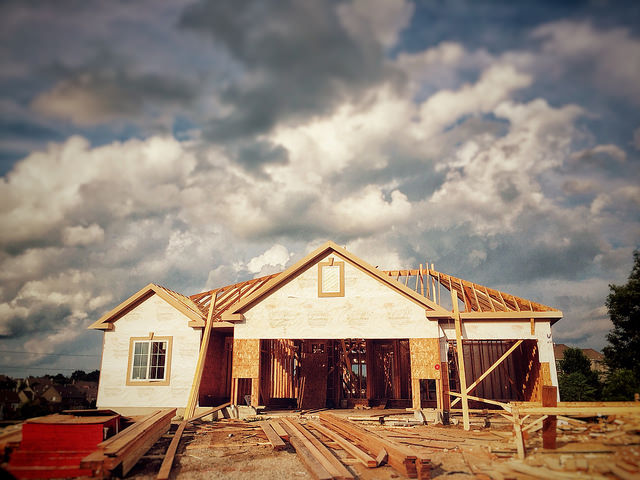
House under construction with wooden frames and dramatic cloudy sky.

Down Payment Savings By The Day

Coming up with a down payment can be a struggle, especially for first-time buyers. That’s because – unlike repeat buyers who can use the sale of their current house to help fund their new home – first timers have to come up with the money the old fashioned way. That means, saving it – which can sometimes be an obstacle for younger buyers. A new report from realtor.com takes a look at just how much you’d need to set aside each day in order to save up the average down payment in each of the country’s 15 largest metro areas. To calculate this, they took the median listing price and average down payment in each area, then figured out how much you’d need to save each day over 5 and 10 year periods. For example, to save the average down payment on a median-priced home in the New York metro area, you’d have to save $19.49 every day for 10 years. On the other hand, saving the same amount each day would be enough to come up with a down payment in Phoenix in just 5 years. But what if you don’t have $20 to put away each and every day? Well the article recommends things like putting aside tax refunds and work bonuses, picking up a weekend job, or cutting back on spending. More here.

Money 34

How Renters & Owners See Buying Differently

The National Association of Realtors’ Housing Opportunities and Market Experience survey asks Americans about their confidence in the economy and views on the current real estate market. According to the most recent results, there’s a growing gap between renters and homeowners when it comes to how they view buying a home in today’s market. In fact, the survey found 62 percent of renters said it was a good time to buy – 6 percent lower than it was at the end of last year. On the other hand, 80 percent of current homeowners say now’s a good time to buy. Lawrence Yun, NAR’s chief economist, says there’s a fairly simple reason for the disparity. “Most homeowners appear to realize that if they’re ready to sell, they’ll likely find a buyer rather quickly and be able to use the sizeable equity they’ve accumulated in recent years towards their next home purchase,” Yun said. “Meanwhile, renters interested in buying continue to face minimal choices, strong competition, and home prices growing faster than their incomes.” Combined with the fact that many renters are young, saddled with student loan debt, and facing rapidly rising rent, there are many obstacles facing young Americans who want to buy. However, as more homeowners take advantage of market conditions and put their homes up for sale, the market will balance and help provide more opportunities for potential buyers. More here.

Eye-Glasses

Mortgage Rates Continue To Fall


According to the Mortgage Bankers Association’s Weekly Applications Survey, average mortgage rates fell again last week across all loan categories, including 30-year fixed-rate mortgages with both conforming and jumbo balances, loans backed by the Federal Housing Administration, and 15-year fixed-rate loans. Mortgage rates are now at their lowest level since May 2013. Michael Fratantoni, MBA’s chief economist, told CNBC rates continue to fall because of economic volatility overseas. “Mortgage rates dropped again last week to their lowest level in more than 3 years, as investors continued to seek safety in US assets given the global turbulence following the Brexit vote,†Fratantoni said. That economic uncertainty has rates falling and refinance activity up. Last week, mortgage application demand increased 7.2 percent largely due to a spike in the refinance index. On the other hand, purchase activity – which is generally less sensitive to rate fluctuations – was relatively flat from the week before and down 5 percent year-over-year. But, because the July 4th holiday fell on a different week last year, those numbers may be slightly skewed. The MBA’s weekly survey has been conducted since 1990 and covers 75 percent of all retail residential mortgage applications. More here.
Illuminated red arrow sign pointing downwards on wooden background.

How Price Increases Might Benefit Buyers


For prospective home buyers, price increases can be complicated. When you’re looking for a house to buy, you want prices to stay low so you can find a great deal but – after you’ve signed the papers and moved in – your opinion quickly changes. Once you own the house, any increase in the value of the property is welcome news. The higher, the better. However, there is one way rising prices can benefit buyers before they’ve closed the deal. For example, prices rise faster in markets where there aren’t enough available homes for sale to meet buyer demand. In these markets, buyers will find more competition and declining affordability conditions. On the other hand, those same price increases also mean current homeowners are gaining equity and may be more likely to put their home up for sale, knowing they can sell it at a good price. That is especially true in today’s market. In fact, according to a new report from Black Knight Financial Services, the number of underwater homeowners has fallen from 29 percent in 2012 to 5.6 percent at the end of the first quarter of this year. That improvement means a lot of homeowners who may’ve been waiting to regain positive equity before selling their home may now be ready to sell. And, as more homes become available for sale, current buyers will not only have more homes to choose from but the overall market will be more balanced, helping affordability conditions. More here.

A bright red "SOLD" sign displayed on a white surface outdoors.

Survey Asks What Makes A House A Home


There are plenty of surveys asking prospective home buyers what features are most important to them when looking for a house to buy. Most of them find buyers naming storage space and energy efficiency among their top priorities. But extra closets and low energy bills aren’t things normally associated with making a new house feel like home. So what does make a house a home? A recently released survey from IKEA tries to answer that question by exploring how people feel in their house and what makes them feel most at home. For example, 63 percent of respondents said they cook to create the feeling of home and associate certain foods with being at home. Among younger respondents, playing music was an important part of achieving that feeling, with 65 percent of respondents between the ages of 18 and 29 saying they play music to get a homey feeling. Smells and sounds play a big role in what makes us feel safe and comfortable but social interaction and privacy are also important. Nearly 50 percent of respondents said home is where they have their most significant relationships while, at the same time, 25 percent said they’d choose to spend an hour alone if they had one to spare. Overall, survey respondents seemed to feel experiences were more important than things and wanted their homes to reflect their desires and give them a place to do what they most love. More here.

Miniature model houses with a focus on one central home.

Household Growth Is On The Rise


Following the housing crash, the homeownership rate fell from its peak and the number of Americans forming new households slowed. But according to a new report from Harvard University’s Joint Center for Housing Studies, household growth is once again on the rise. In fact, the report shows that the pace of household growth increased from 653,000 in 2013 to 1.0 million in 2014 and1.3 million in 2015. That’s good news for the health of the housing market, especially since young Americans are expected to form 2 million households per year over the next 10 years. Chris Herbert, managing director of Harvard’s Joint Center for Housing Studies, says there are still some lingering challenges holding buyers back, however. “Tight mortgage credit, the decade-long falloff in incomes that is only now ending, and a limited supply of homes for sale are all keeping households – especially first-time buyers – on the sidelines,†Herbert said. “And even though a rebound in home prices has helped to reduce the number of underwater owners, the large backlog of foreclosures is still a serious drag on homeownership.†Still, evidence shows buyer demand is high and homeownership continues to be a goal for most Americans. As Herbert says, “The question is not so much whether families will want to buy homes in the future, but whether they will be able to do so.†More here.

Rustic brick house under a vibrant blue sky with scattered clouds.

Money Matters Hold Back Housing Sentiment


The number of Americans who say it’s a good time to sell a house rose 5 percent in June, according to Fannie Mae’s monthly Home Purchase Sentiment Index. That represents an all-time survey high. Combined with a 3 percent bump in the number of survey respondents who said it was a good time to buy a house, the results seem to show an increasing optimism about the real estate market. But though participants may see opportunity, concerns about their personal income and the direction of the overall economy may be holding them back. In fact, money worries led to a 2.1 percent drop in overall sentiment from the previous month’s highs. “The HPSI’s pullback in June from last month’s survey-high reading suggests a slight weakening in the 12-month outlook for housing activity,†Doug Duncan, Fannie Mae’s senior vice president and chief economist, said. “Pending home sales have pulled back in the face of continued home price growth, and we’re seeing some softening in the higher priced components of the market. Growing pessimism about the overall direction of the economy gives us further pause as it now stands at the highest level we’ve seen in our National Housing Survey in the last two years.†According to Duncan, real improvement will require more affordable homes available for sale and a significant boost in Americans’ income growth perceptions. More here.

Close-up of George Washington on a US one-dollar bill.

Thank you for your upload